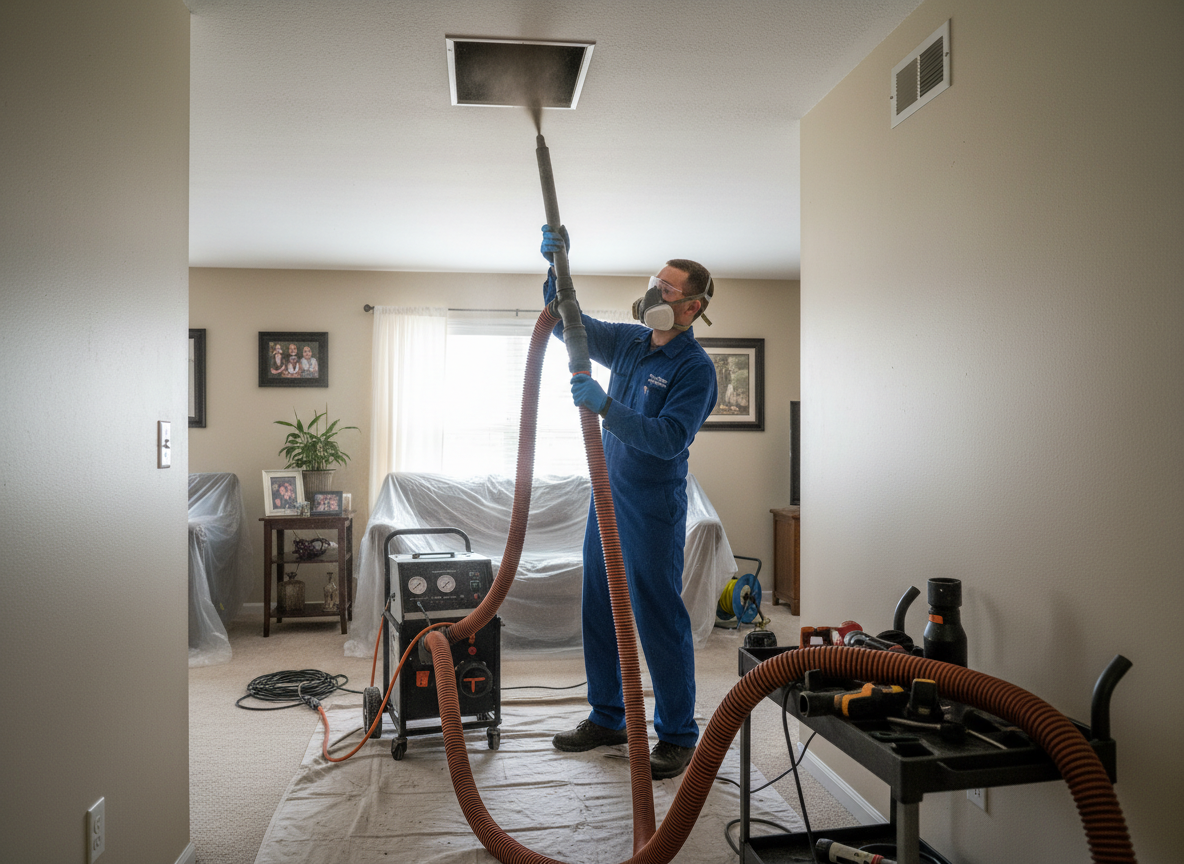
Centerville homes built from the 1960s through the 1980s often feature rigid metal trunk lines with flexible branch runs that trap fine Ohio dust and pollen. These systems run through unconditioned crawl spaces and attics where temperature swings cause condensation and allow microbial growth on interior surfaces. A proper cleaning requires negative-air machines rated for the full cfm of the HVAC blower plus mechanical agitation tools that reach every 90-degree elbow without damaging the duct walls.
Seasonal humidity in the Centerville area loads return ducts with outdoor allergens during spring and fall, while winter heating cycles bake settled debris into a fine powder that re-circulates. Technicians must map every register and booster fan before work begins because many split-level and ranch layouts hide secondary returns behind built-in cabinetry or under stairwells. Skipping these hidden sections leaves the majority of the system untouched.
Homeowners in the Wilmington Pike corridor frequently report musty odors after heavy rains because sump-pump discharge lines and foundation drains sit close to duct runs in older slabs. Cleaning crews isolate these zones with blocking plates and HEPA filtration to prevent cross-contamination into living spaces. Post-clean verification includes static-pressure readings at the furnace to confirm airflow has returned to design specifications.
Technician insight
In Centerville, the thing that catches most people out with Residential Air Duct Cleaning is the number of 1970s split-levels along Wilmington Pike where the main return trunk runs under the lower-level slab and collects water vapor from nearby foundation drains.
Ranch Home Near Yankee Street
Homeowner reported persistent allergy symptoms after opening windows in spring. Inspection showed heavy pollen and dust cake in the attic flex runs feeding the master bedroom. Crew isolated the system, agitated the lines under negative pressure, and removed several pounds of compacted debris. Airflow at the farthest registers increased and the musty smell disappeared.
How it works
- 1
System Mapping
Locate every supply and return in the Centerville home, note access points, and identify any booster fans or dampers before equipment is staged.
- 2
Isolation and Containment
Seal off the HVAC unit and create negative pressure zones so loosened debris cannot enter living areas during agitation.
- 3
Mechanical Agitation and Vacuum
Use rotary brushes and compressed-air whips sized for the duct diameter while the vacuum pulls debris into sealed collection containers.
- 4
Post-Clean Verification
Reassemble registers, measure static pressure at the furnace, and confirm no visible residue remains at accessible points.
Pricing
Upfront quotes provided after on-site inspection; final cost depends on total linear feet of duct, number of returns, and access difficulty in Centerville homes.