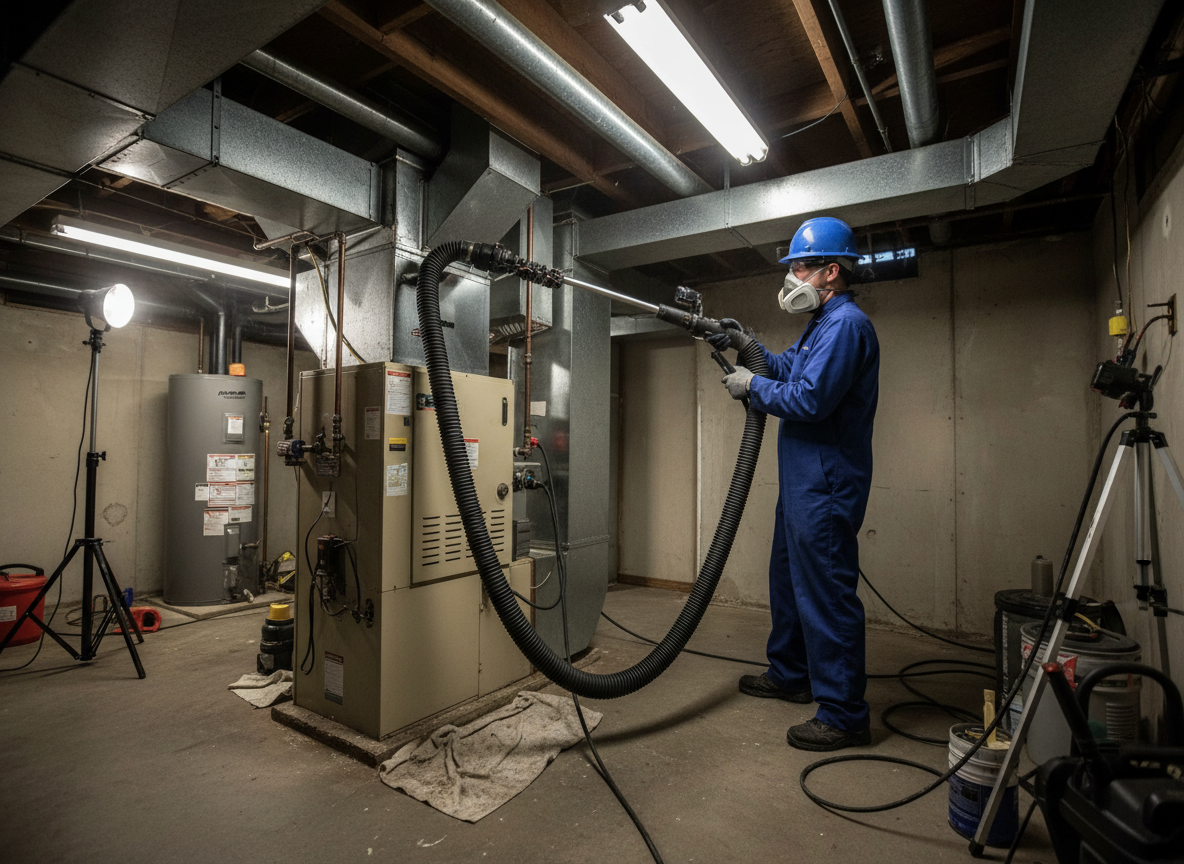
Centerville homes built from the 1960s through the 1980s often feature rigid metal duct runs that collect fine silt from Montgomery County fields and pollen tracked in during summer. Furnace and duct cleaning here starts with locating the main trunk lines behind finished basement ceilings or in crawl spaces common along the Wilmington Pike corridor. Technicians use negative-air machines sized for the typical 2,000 to 2,800 square foot ranch or two-story layout to pull debris without pressurizing the system into living spaces.
Winters that drop below freezing for weeks force furnaces to run long cycles, packing dust and lint against blower wheels and heat exchangers. In these conditions, restricted airflow raises static pressure and shortens equipment life. Cleaning crews remove the blower assembly when possible, brush the exchanger surfaces, and vacuum the return plenum where pet hair and drywall dust from recent renovations commonly settle. Edge cases include homes with flex duct sections added during attic conversions that can collapse if not supported during negative-air extraction.
Local building practices in Centerville sometimes leave limited access panels, requiring temporary cuts that are patched and sealed to code after service. Crews also check for disconnected boots at floor registers on slab homes near the golf course neighborhoods, a frequent source of unfiltered air entering the system. Post-cleaning airflow readings confirm the job restored original cubic-feet-per-minute capacity without introducing new leaks.
Technician insight
In Centerville, the thing that catches most people out with furnace and duct cleaning is how quickly fine silt from nearby fields packs into return plenums on homes built before 1990. Constant winter furnace cycles pull that dust straight through unsealed joints, and homeowners usually only notice when the blower starts straining. Checking those older trunk lines behind finished ceilings before quoting saves everyone surprises on the day of service.
Restricted Airflow in a 1978 Centerville Ranch
The homeowner reported weak heat on the second floor during January cold snaps. Inspection found the main return trunk clogged with dust and pet hair where it ran through the crawl space. Crews used a 16-inch brush head and negative air to clear the line, then resealed three loose boots at floor registers. Airflow readings returned to the original design range and the furnace cycled normally again.
How it works
- 1
System Inspection
Technicians map all supply and return runs, note access points, and check for disconnected sections common in Centerville homes.
- 2
Equipment Setup
Negative-air machines and brushing tools are staged at the furnace location to contain debris during the entire job.
- 3
Mechanical Cleaning
Blower, heat exchanger, and all accessible ducts are brushed and vacuumed to remove packed winter dust and lint.
- 4
Final Verification
Airflow is measured at registers and the system is reassembled with new filters installed before departure.
Pricing
Upfront quotes based on home size, number of runs, and furnace condition; no hidden fees after inspection.