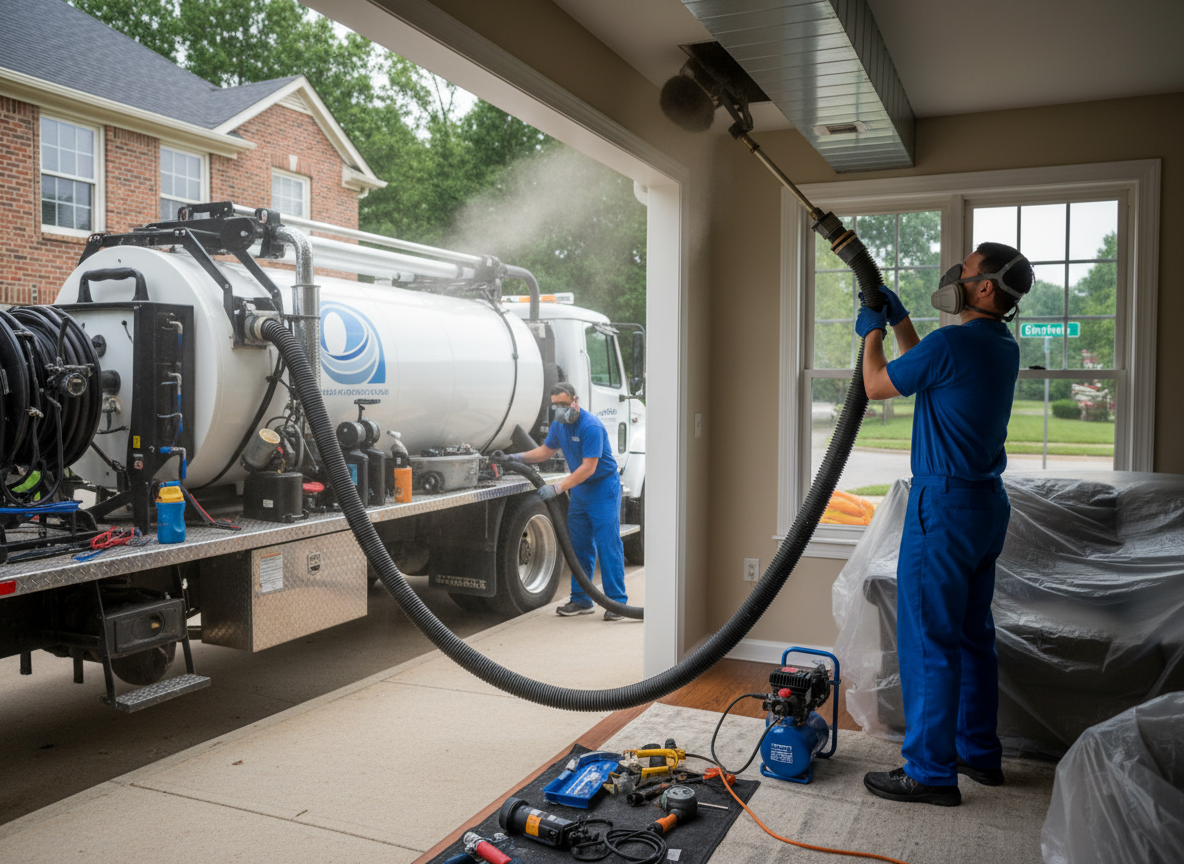
Centerville homes built from the 1960s through the 1990s often feature rigid metal trunk lines that run through crawl spaces or unconditioned attics. Over decades these lines collect a mix of construction dust, insulation fibers, and fine silt carried in during spring pollen seasons. A full-system cleaning must reach every branch run and register boot; skipping the returns leaves the blower motor pulling the same contaminants right back into living spaces.
Moisture from humid Ohio summers can combine with that dust to create conditions where microbial growth starts along the bottom of the main trunk. Technicians use negative-air machines rated for the home’s square footage while brushing each line so loosened material travels straight into the collection unit rather than settling elsewhere in the duct. Access points are cut only where necessary and sealed with code-compliant patches afterward.
Homeowners in the Centerville area frequently report uneven airflow after a decade of no service. Cleaning restores balance only when the technician also inspects and clears the evaporator coil and blower wheel during the same visit; otherwise the motor continues to work against restricted passages and re-circulates fine particles.
Scheduling the work when outdoor temperatures sit between 50 and 75 degrees avoids stressing the HVAC system while filters are removed. The job typically finishes in four to six hours for a two-story Centerville residence, after which the system is restarted and static pressure is checked at the main plenum to confirm improved flow.
Technician insight
In Centerville the thing that catches most people out with whole house air duct cleaning is the number of homes where the main trunk runs through a finished basement ceiling with almost no access panels; once you open a couple you usually find the original installers never sealed the joints, so half the dust load is sitting on top of the drywall instead of inside the duct.
Uneven airflow in a 1978 Centerville split-level
The homeowner noticed one upstairs bedroom stayed warmer than the rest of the house. Inspection showed the supply run serving that room had separated at a joint hidden above a hallway closet. After reattaching and cleaning the full system, measured airflow at the problem register increased and the temperature difference disappeared.
How it works
- 1
Initial System Inspection
Technician examines every accessible trunk, branch, and register in the Centerville home to map the layout and note any damaged or disconnected sections before equipment is brought inside.
- 2
Negative-Air Setup
A HEPA-rated vacuum is connected to the main trunk at 6480 Wilmington Pike service standard, creating continuous suction so all loosened material is captured rather than escaping into living areas.
- 3
Mechanical Agitation
Rotating brushes and compressed-air whips travel each line from register to trunk, breaking up compacted dust layers typical in homes near the Centerville municipal building.
- 4
Final Airflow Verification
After cleaning, static pressure and airflow are measured at the plenum and several registers to confirm the system moves air more freely than before the service.
Pricing
Pricing varies by home size, number of stories, and duct accessibility; most Centerville whole-house jobs fall in a mid-range bracket that reflects older metal ductwork rather than flexible runs.