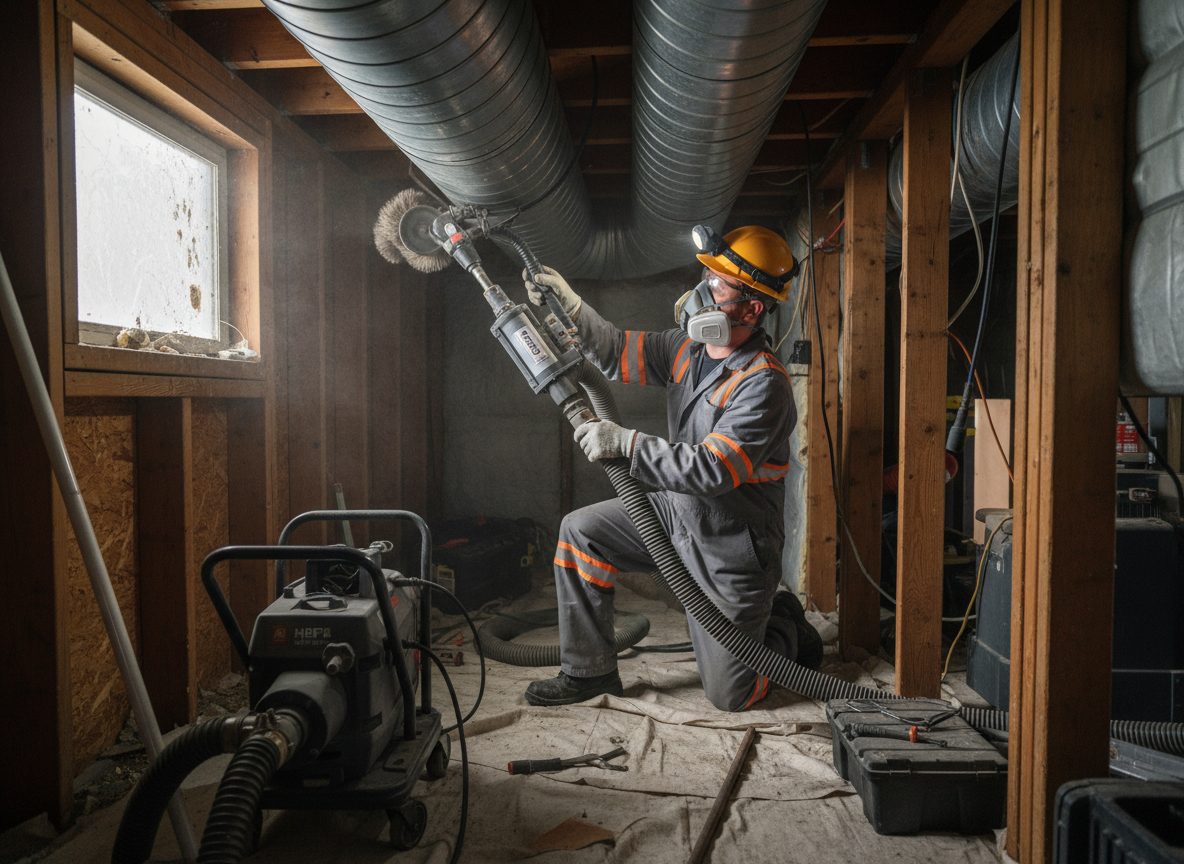
Centerville homes often feature a mix of single-story ranches and two-story builds with attic or crawlspace duct runs. These layouts create long horizontal runs where dust, pollen from nearby fields, and pet hair settle in low spots. Professional duct cleaning addresses the full trunk and branch lines rather than just registers, preventing restricted airflow that shows up first on upper floors during summer humidity spikes.
Flexible duct sections common in Centerville properties from the 1980s onward require gentler agitation tools to avoid tears at the connections. Rigid metal runs in older sections near downtown Centerville can handle heavier brushing but still need negative-pressure containment so debris does not re-enter living spaces. Technicians check for disconnected joints or crushed sections before starting, because those conditions turn a standard cleaning into a repair job.
Access points matter in the area’s split-level homes along Wilmington Pike. Removing and resealing registers without damaging surrounding drywall takes extra time when insulation has settled around the boots. After cleaning, a final camera sweep confirms no residual lint remains in the return plenum, which is a frequent missed spot when systems pull air from laundry rooms or garages.
Access Challenges in Split-Level Homes
Split-level layouts around Centerville frequently place returns behind finished walls or in tight utility closets. Reaching these without cutting access panels requires portable lighting and angled tools that fit the existing openings. Skipping this step leaves the return side collecting the same contaminants the supply side just had removed.
Technician insight
In Centerville, the thing that catches most people out with professional duct cleaning is the way older flex duct sags between joists along the Wilmington Pike corridor. Those low spots trap pollen and pet hair that standard vacuuming never reaches, and trying to force a brush through without supporting the run first tears the outer jacket.
Restricted Airflow in Two-Story Centerville Home
Homeowner reported weak airflow on the second floor during warm months. Inspection showed heavy lint accumulation where the main trunk crossed the attic in a 1980s build. Crew supported the flex sections, used rotating brushes to loosen material, and extracted it under negative pressure. Airflow balanced after reassembly with no new damage to the ducts.
How it works
- 1
Initial System Walkthrough
Technician inspects all accessible ducts, registers, and the furnace or air handler to note any disconnected sections or crushed flex runs common in Centerville homes.
- 2
Containment Setup
Negative-air machines and sealed registers prevent loosened debris from entering living spaces during agitation of trunk lines and branches.
- 3
Mechanical Agitation and Extraction
Rotating brushes and compressed-air whips loosen buildup while the vacuum system pulls material out through the main trunk at the unit.
- 4
Final Inspection and Reassembly
Camera verification confirms clear passages, then registers are reinstalled and the system is run to check airflow balance.
Pricing
Upfront quotes given after walkthrough; cost depends on number of runs, access difficulty, and whether flex sections need extra care.