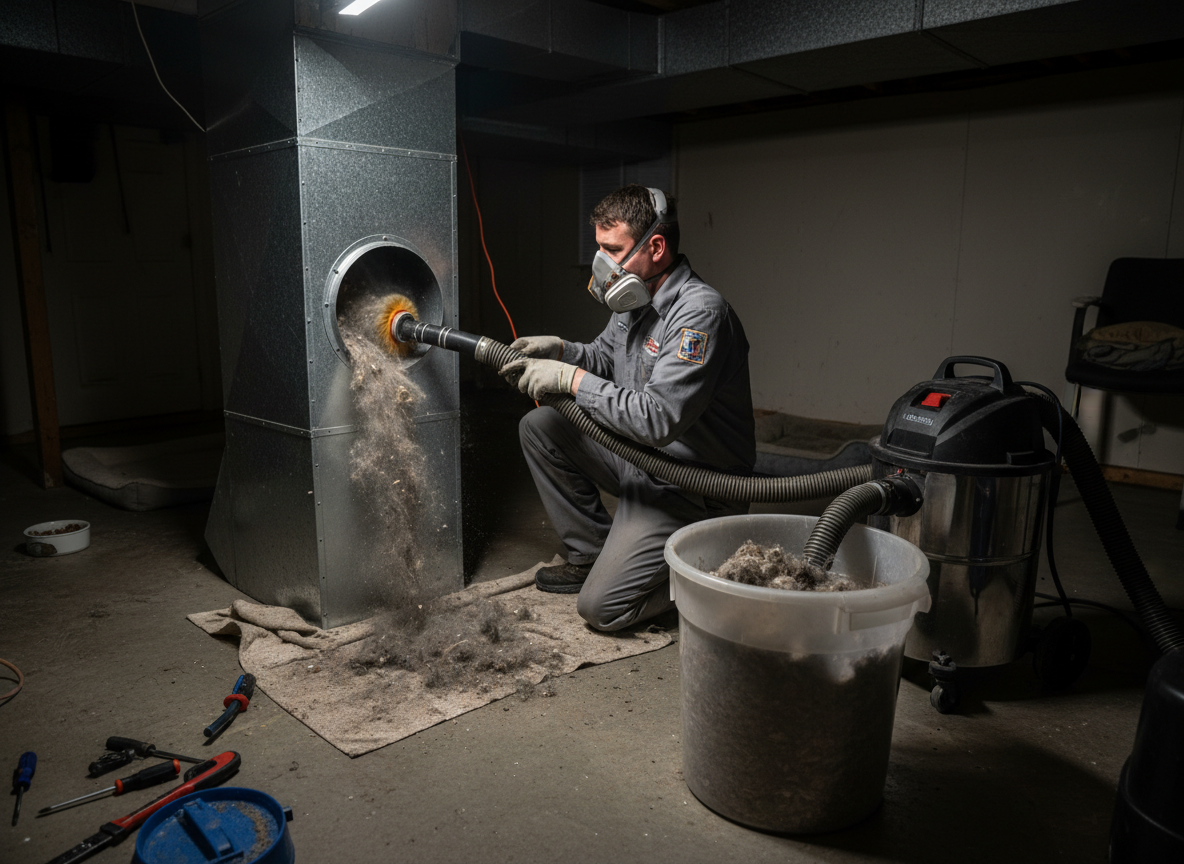
Centerville homes built from the 1960s onward often feature sheet-metal duct runs that run through crawl spaces and attics where pet hair settles on the bottom surfaces and clings to the seams. Dry winter air from the furnace blower keeps the hair airborne until it packs into the return grilles and the first few feet of trunk line. Standard vacuuming misses this layer because the hair mats against the metal rather than staying loose.
We use a combination of negative-air machines and rotary brushes sized for 6-inch to 12-inch residential ducts typical along Wilmington Pike and in the older sections near the golf course. The brushes loosen the compacted hair without denting the thin-gauge metal found in many 1970s and 1980s houses. After brushing we pull the debris into a sealed collection unit so it does not re-enter living spaces.
Homeowners notice the difference first at the supply registers nearest the furnace where pet hair used to appear within days of vacuuming floors. Because Centerville sits in a shallow valley, temperature swings in spring and fall cause the system to cycle more often, pushing any remaining hair farther into the branches. One thorough cleaning usually resets the system for the next heating season.
We also inspect the filter slot and blower compartment on every job because hair that bypasses the filter lands directly on the heat exchanger and reduces airflow. This step is especially useful in two-story homes along Bigger Road where the returns are located on the upper level and pull more volume during peak winter use.
Technician insight
In Centerville the thing that catches most people out with pet hair duct cleaning is the return plenum in split-level homes near the creek; the low ceiling keeps the metal cold in winter so the hair sticks hard to the bottom and needs extra passes with the brush before the negative air pulls it out.
Two-story on Bigger Road
The homeowner reported heavy pet hair reappearing on the upstairs registers within a week of vacuuming. We found the main return in the second-floor hallway packed solid from years of golden-retriever shedding. After brushing the trunk and both floors of branches we restored full airflow and the hair stopped circulating.
How it works
- 1
Initial Walk-Through
We inspect every accessible register, the furnace, and the main trunk lines to map where pet hair has collected in the Centerville home.
- 2
Negative-Air Setup
A sealed vacuum unit is attached to the main trunk to create continuous suction while we work each branch.
- 3
Rotary Brush Cleaning
Flexible brushes sized for local duct diameters loosen the matted hair without damaging the sheet metal.
- 4
Final Register and Blower Check
We vacuum the blower compartment and verify that registers are free of loose hair before restoring airflow.
Pricing
Cost depends on the number of runs, stories, and how packed the hair has become; we provide an exact figure after the walk-through.