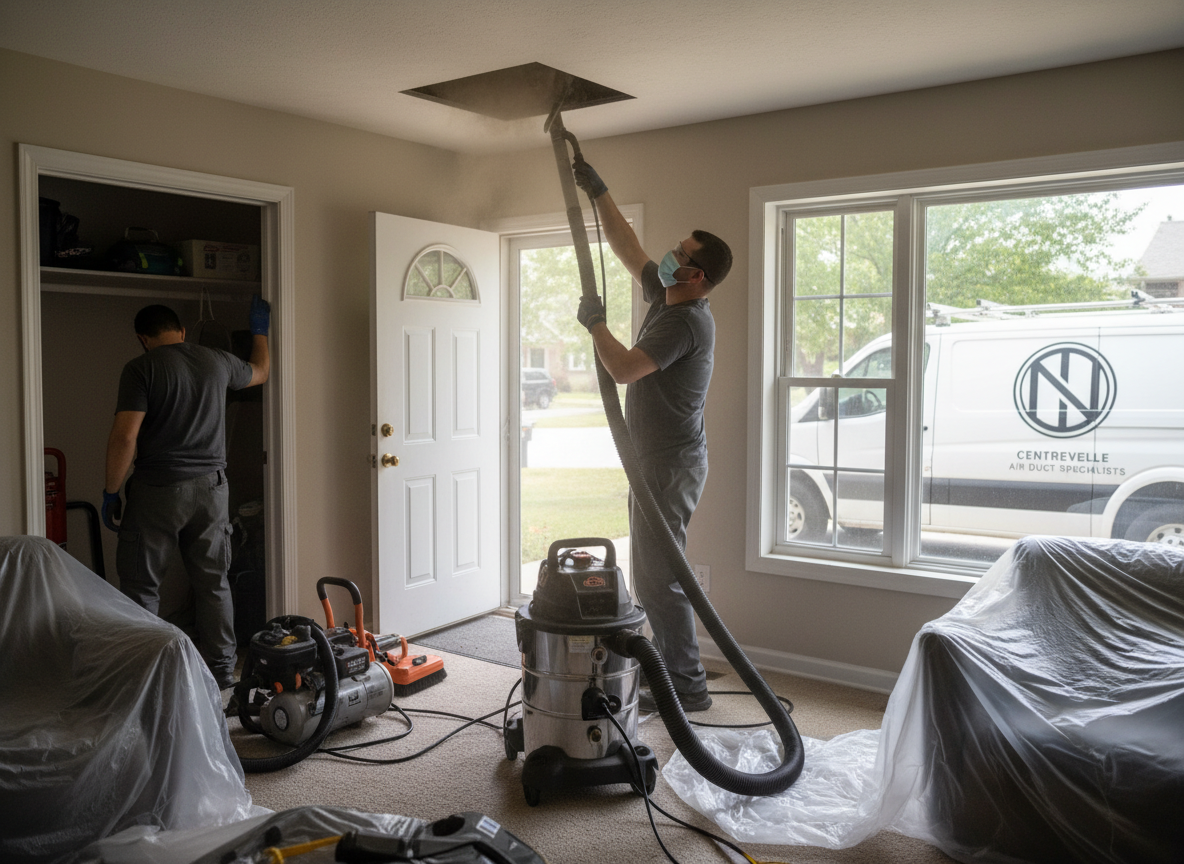
Centerville homes built from the 1960s onward often feature trunk-and-branch duct runs in crawl spaces or attics that collect pollen, insulation fibers, and fine road dust carried in from I-675 and surrounding farmland. When winter heating cycles run continuously, that material packs against registers and reduces airflow, forcing furnaces to work harder. Cleaning crews typically start at the main trunk near the air handler, then work outward with negative-air machines sized for 3- to 5-ton systems common in the area.
Moisture from humid Ohio summers can combine with dust to form a light biofilm inside flex duct sections, especially where runs cross unconditioned attics. Technicians inspect for collapsed or disconnected sections before brushing, because disturbing those lines without repair can push debris into living spaces. Access panels are cut only when existing service openings are insufficient, then sealed to code with mastic and mesh.
Residents near the golf courses and older subdivisions south of Centerville often report musty odors after heavy spring rains because standing water in low-lying yards raises indoor humidity. Duct cleaning alone does not fix drainage issues, but removing the accumulated material lets homeowners see whether the odor returns. Every job ends with a visual check of the blower compartment and a filter recommendation matched to the home’s system.
Technician insight
In Centerville the thing that catches most people out with local air duct cleaning is the number of 1970s split-level homes where the main trunk sits in a low crawl space that floods after heavy rain; if you do not pump that water out first the loosened dust turns to mud and clogs the vacuum hose halfway through the job.
Split-Level Home Near Wilmington Pike
Homeowner noticed weak airflow on the upper floor after two winters of continuous furnace use. Inspection showed the trunk line in the crawl space half-filled with fine silt from seasonal seepage. Crew pumped standing water, then brushed and extracted the packed material in two sections. Airflow returned to all registers and the musty smell disappeared within a day.
How it works
- 1
Initial Walk-Through
Technician inspects every accessible register, the air handler, and visible duct runs to note access points and any damaged sections.
- 2
Setup Negative Air
A HEPA-filtered vacuum is connected to the main trunk and the system is placed under negative pressure before agitation begins.
- 3
Agitate and Extract
Rotary brushes and compressed-air whips loosen debris while the vacuum pulls material out; flex lines receive gentler tools to avoid tearing.
- 4
Final Inspection and Seal
All registers are vacuumed, access points are closed, and the homeowner walks the system to confirm airflow at each vent.
Pricing
Upfront quote after the walk-through; final price depends on number of runs and access difficulty.