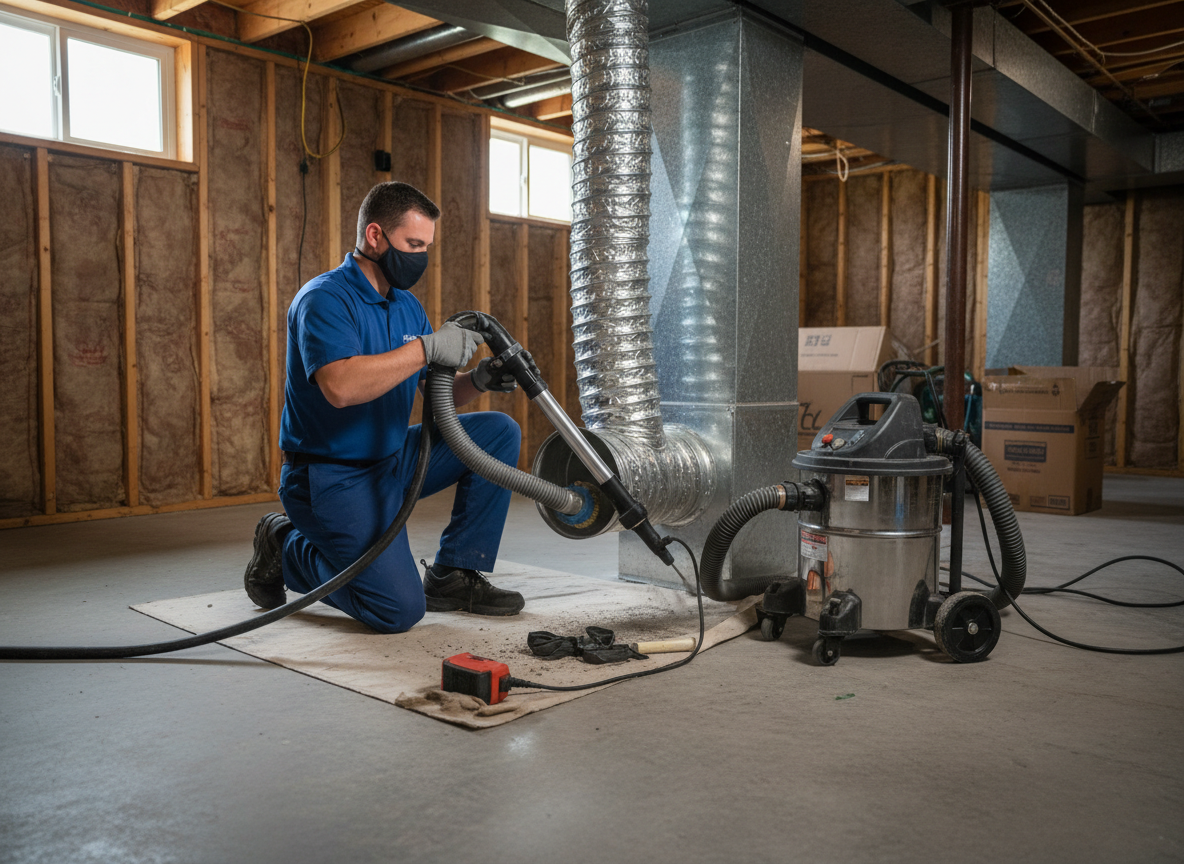
Centerville homes built from the 1960s through the 1980s often feature trunk-and-branch duct runs that run through crawlspaces or unconditioned attics. These systems collect fine clay dust from local soil, pollen from the Great Miami River corridor, and winter heating residue. When homeowners notice uneven airflow or musty odors after the first cold snap, the issue usually traces back to restricted returns rather than the furnace itself. Proper cleaning requires accessing each branch through existing registers and using negative-air machines sized for the home’s square footage.
Spring and fall bring rapid humidity swings in Montgomery County that cause dust to cake on metal surfaces inside the ducts. In neighborhoods like Yankee Trace and around the Centerville Library area, many single-story ranches have long horizontal runs with limited access points. Skipping the supply-side cleaning leaves behind the very particles that trigger allergy complaints. Technicians who work these streets daily know to check for disconnected flex duct at the plenum before any vacuuming begins.
Older homes near Wilmington Pike frequently have had multiple furnace replacements, leaving mismatched duct sizes and patched joints. These patches become collection points for debris during high-wind events common along the I-675 corridor. A full cleaning includes brushing the main trunk, vacuuming each branch, and wiping the plenum interior so the next heating season starts with clear airflow rather than recirculated dust.
Residents in Centerville and nearby Kettering often schedule service right after leaf drop because fallen leaves get pulled into exterior intakes. Clearing the ducts at that time prevents the material from breaking down into finer particles that are harder to remove later. The work is done from the address at 6480 Wilmington Pike outward to surrounding streets without requiring homeowners to leave during the process.
Technician insight
In Centerville the thing that catches most people out with Duct cleaning services near me is the number of 1970s homes where the original flex duct runs through exterior walls have sagged and collected standing water after heavy spring rains along the creek beds near Yankee Trace. That moisture turns ordinary dust into a concrete-like layer that standard brushes cannot move without first cutting access panels.
Sagged flex duct in Yankee Trace home
A Centerville homeowner reported weak airflow from every supply vent after the first October cold snap. Inspection revealed two sagged flex runs in the crawlspace that had collected water and packed dust. The sections were replaced, the remaining rigid duct was brushed and vacuumed, and airflow returned to normal across all rooms.
How it works
- 1
Initial System Inspection
Technician arrives at the Centerville address and examines every accessible register, the furnace cabinet, and the main trunk line for visible blockages or disconnected sections.
- 2
Negative Air Setup
A negative-air machine is connected to the main trunk while registers are sealed one at a time to create directed airflow that pulls loosened debris out of the system.
- 3
Mechanical Brushing
Rotating brushes sized for each duct diameter travel the full length of supply and return runs, breaking up compacted dust without damaging metal or flex connections.
- 4
Final Vacuum and Verification
All branches are vacuumed clean, registers are wiped, and airflow is rechecked at multiple points before the system is returned to normal operation.
Pricing
Upfront quotes based on number of runs, access difficulty, and whether flex duct sections need replacement.