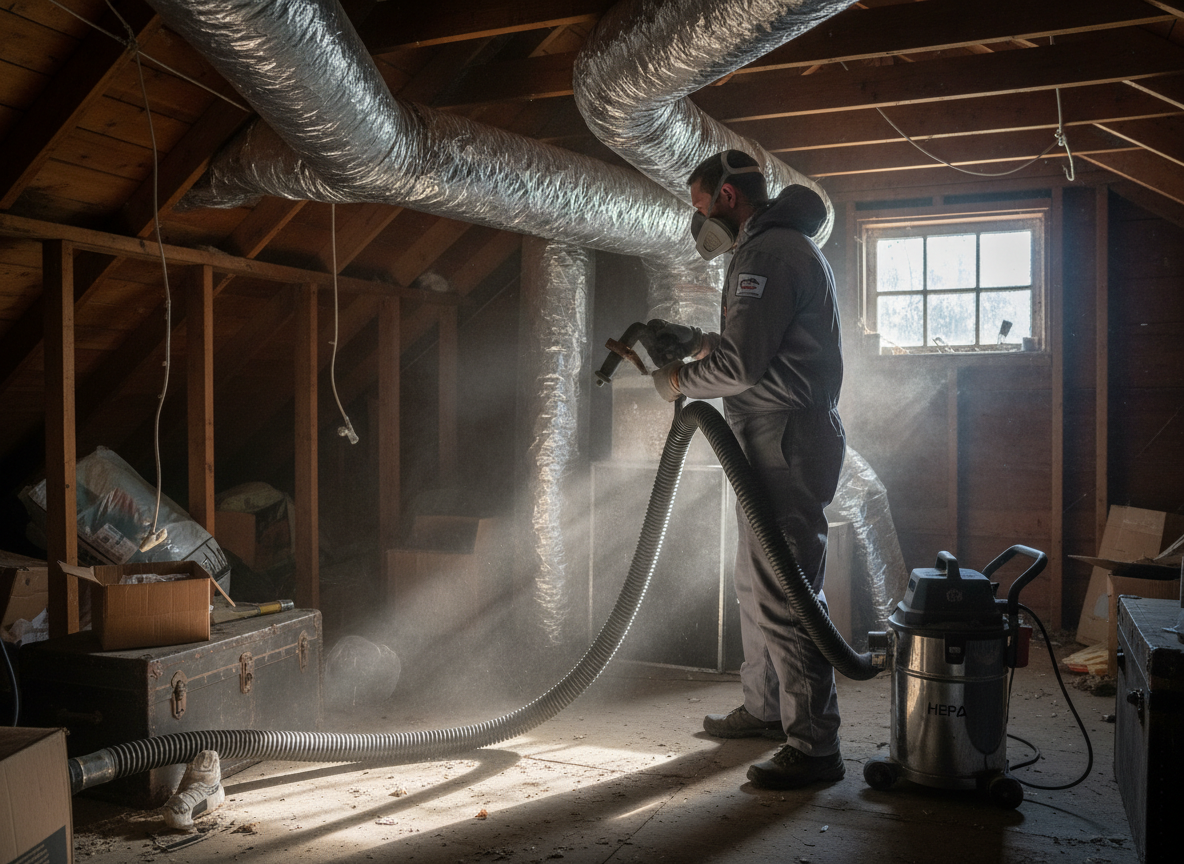
Attic duct cleaning in Centerville targets the flexible and rigid runs that sit above living spaces in many Montgomery County homes. These ducts often collect fine dust, insulation fibers, and rodent debris because they are rarely reached during whole-house cleanings. Technicians must work around blown-in insulation, truss spacing, and low-clearance areas common in ranch-style properties near Wilmington Pike. Proper containment prevents material from falling into finished ceilings below.
Access points in Centerville attics frequently require temporary removal of insulation batts or careful navigation around HVAC equipment. Technicians use negative-air machines with HEPA filtration to keep loosened particles from re-entering the home. In older homes built before modern vapor-barrier standards, ducts may show condensation stains that indicate hidden moisture issues. Addressing these during cleaning helps prevent future mold growth on the duct surfaces.
Edge cases include ducts routed through knee walls or cathedral ceilings where standard brushes cannot reach without disassembly. Homeowners in the Centerville area sometimes discover that previous renovations have left disconnected sections that allow unfiltered air to bypass filters entirely. A thorough inspection identifies these gaps before any vacuuming begins.
Safety protocols require checking for knob-and-tube wiring remnants and ensuring attic ventilation remains unobstructed after work. Crews document before-and-after conditions with photos so residents can verify the extent of material removed from their specific duct layout.
Technician insight
In Centerville, the thing that catches most people out with attic duct cleaning is how quickly insulation shifts in the low-pitch roofs common along Wilmington Pike; one wrong step during access can create a mess that takes longer to fix than the actual cleaning.
Disconnected Run in a Centerville Ranch
A homeowner noticed uneven airflow on the second floor. Inspection revealed a flexible duct that had separated at a joint hidden behind insulation near the peak. The crew reconnected the section, extracted accumulated debris from the now-isolated run, and restored the insulation blanket. Airflow balanced across the system and the homeowner reported consistent temperatures upstairs.
How it works
- 1
Initial Attic Assessment
Technicians enter the attic through existing access panels and map every duct run while noting insulation type and any visible damage.
- 2
Containment Setup
Negative-air equipment is positioned at the attic opening and sealed to prevent dust migration into living areas below.
- 3
Agitation and Extraction
Rotating brushes and compressed air tools loosen debris along each duct section while the vacuum system pulls material out.
- 4
Final Inspection and Reassembly
All access points are checked, insulation is restored where disturbed, and the system is tested for proper airflow.
Pricing
Cost depends on attic accessibility, total linear feet of duct, and whether insulation must be moved or replaced.