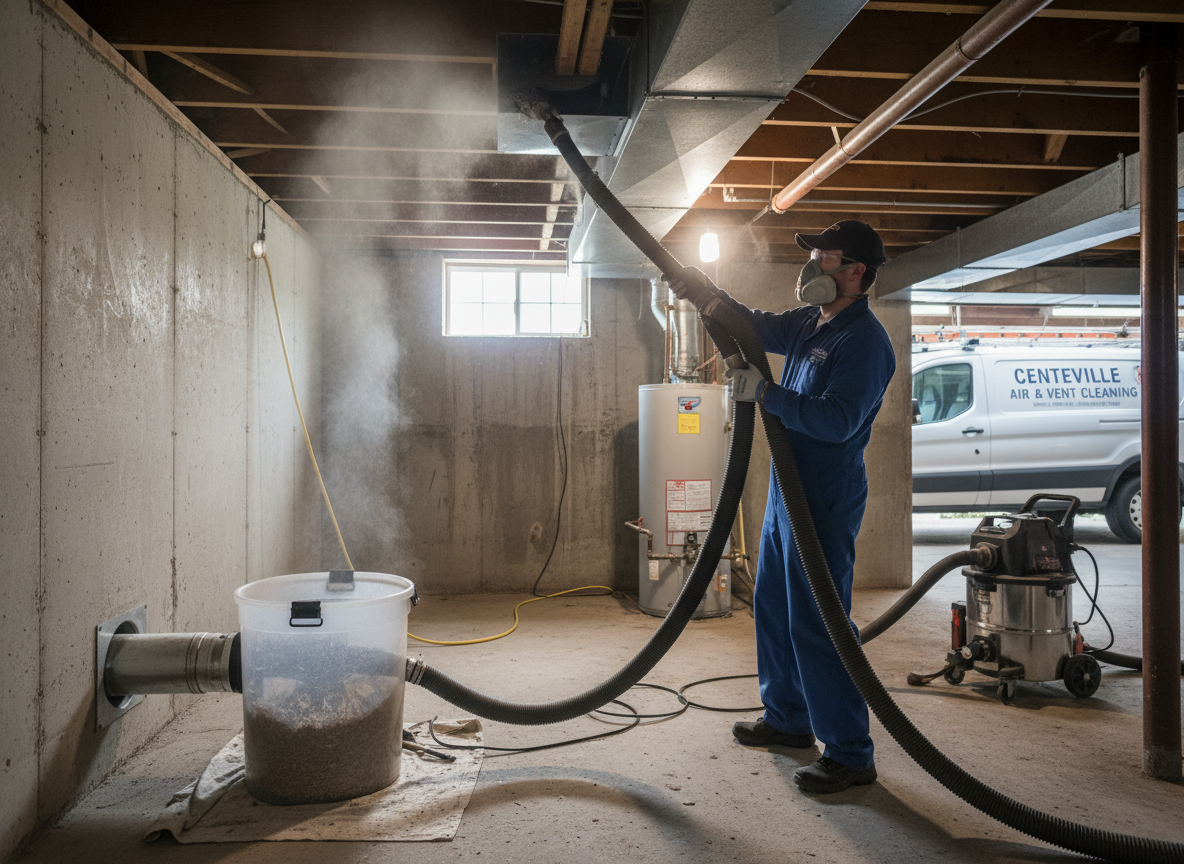
Centerville homes, especially those built in the 1960s through 1980s along corridors like Wilmington Pike, often feature original galvanized ductwork that collects fine Ohio dust and pollen over decades. Seasonal swings from humid summers to freezing winters create condensation points inside the lines, allowing mold spores to settle in low spots near registers. Cleaning these systems requires reaching branch runs that standard vacuums miss, particularly in ranch layouts where ducts run through tight crawl spaces or uninsulated attics.
Dryer vent cleaning becomes critical in Centerville because many two-story homes route vents horizontally through exterior walls facing prevailing winds. Lint packs at elbows and where the line passes through brick or vinyl siding, reducing exhaust flow and raising fire risk. Technicians must disassemble exterior caps and use rotary brushes sized for 4-inch lines to clear compacted material without damaging the thin aluminum sections common in local construction.
Edge cases appear in homes near the creek corridors where higher humidity accelerates dust adhesion inside supply trunks. Technicians inspect for disconnected joints or crushed flex runs that trap debris before any negative-air machine is attached. Proper sealing after cleaning prevents re-entry of attic insulation particles stirred up during Ohio’s spring winds.
Technician insight
In Centerville, the thing that catches most people out with air duct and dryer vent cleaning is the horizontal dryer runs in 1970s split-level homes near the golf course area where winter freeze-thaw cycles loosen attic insulation that then sifts into the ducts through unsealed joints.
Dryer Vent Restriction in Centerville Split-Level
A homeowner noticed longer drying times and musty air from floor registers. Inspection showed compacted lint at two elbows in the exterior wall run and fine insulation particles inside the main supply trunk. Rotary brushing and negative-air extraction cleared the lines, restoring full exhaust flow and eliminating the odor source.
How it works
- 1
Initial Assessment
Technician inspects accessible registers, dryer connection, and exterior vent termination to map duct layout and note any visible damage or blockages.
- 2
System Isolation
Registers are sealed and the HVAC fan is disabled while a negative-air machine is connected to the main trunk to contain loosened debris.
- 3
Mechanical Cleaning
Rotary brushes and compressed air tools agitate dust and lint from duct walls and dryer vent lines, moving material toward the collection unit.
- 4
Final Verification
Registers are reopened, airflow is tested at multiple points, and the dryer vent is checked for clear exhaust before equipment is removed.
Pricing
Upfront quotes based on number of vents, home size, and duct accessibility.